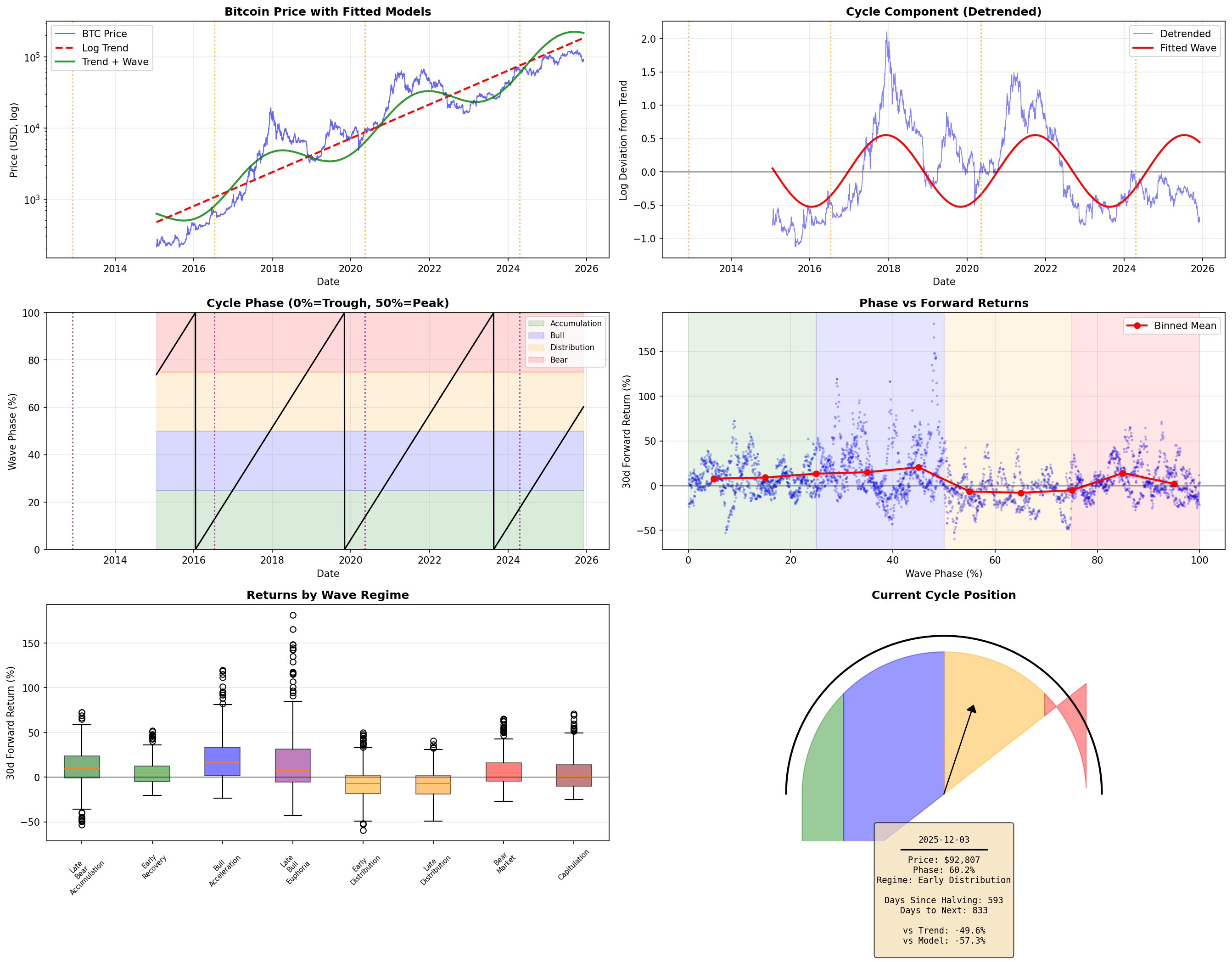
Current cycle position: Early Distribution (Day 593). Historical returns by phase show Distribution consistently underperforms.
Determine which factors predict Bitcoin forward returns, and establish precedence when signals conflict.
I selected three factors, each representing a different hypothesis about Bitcoin price drivers:
| Factor | Hypothesis | Mechanism |
|---|---|---|
| Power Law | Price follows long-term log growth; deviations mean-revert | Network effects drive adoption along predictable curve |
| Halving Cycle | Supply schedule creates ~4-year market cycles | Block reward halving reduces sell pressure, triggers bull runs |
| Fed/Macro | Bitcoin responds to system-wide liquidity | QE/QT and rate changes flow through to risk assets |
The Power Law and Halving Phase signals conflict. This analysis determined which should take precedence.
Power Law Deviation shows the strongest correlation with 90-day forward returns (-0.449 vs -0.289 for Halving Phase).
When I tested "undervalued" observations across different phases, results diverged sharply:
| Scenario | Mean 90d Return | Win Rate |
|---|---|---|
| Undervalued + Bull Phase | +50.3% | 100% |
| Undervalued + Distribution | -13.3% | 6.9% |
The same valuation signal produces opposite outcomes depending on phase.
Power Law's aggregate correlation masks regime-dependent performance. It works during Pre-Halving and Bull phases but fails during Distribution. Halving Phase acts as a regime filter that determines whether valuation signals are reliable.
Undervalued + Distribution (n=159):
| Metric | Value |
|---|---|
| Mean 90d return | -16.6% |
| Win rate | 5.7% |
| 95th percentile | +4.2% |
The undervaluation reading is not reliable during Distribution phase. Historical precedent shows 94% of similar setups produced negative 90-day returns.